Reflections on Plato’s dialogues — or, if I break it out as a separate post, links to reflections — to follow below. The order is that of the Ukemi Audiobooks series The Socratic Dialogues, which dramatizes Benjamin Jowett’s translation with a full cast of great British actors (headlined by David Rintoul as Socrates). Jowett’s translation may be “out of date” from a scholarly perspective (which I am unqualified to judge) but in Rintoul’s hands (vocal chords?) is enduringly lucid. Ukemi also organizes the dialogues loosely according to a traditional early-middle-late periodization, which I gather is a contested approach, but it doesn’t seem to harm the understanding for a first pass. (I’m already suspecting that the “dramatic ordering,” following the chronology of Socrates’ life as best that may be reconstructed, might be more fruitful… but that’s for a second round, and I’m just beginning the first!)
Early Period
Apology. A barnstormer to start in medias res — better, near the end of things. We meet Socrates for the first time as he defends himself, before the assembly, against the charges laid at his door: of being an evildoer and “making the better appear the worse,” of being an atheist and introducing new deities, and of corrupting the youth. He does not succeed, though he is condemned by only a small margin. Socrates here introduces a number of key motives in the corpus: his claim to “know nothing at all” and thus to only be the “wisest” by exposing everyone else’s ignorance (which makes him quite unpopular); the deceptiveness of rhetoricians, who know how to speak elegantly and persuasively, but know really nothing of the Good and therefore of how to make men better; his own role as a sort of “gadfly,” provoking the polis into active self-reflection which it might otherwise neglect, and seeking thus to improve it; the absolute priority of caring for the soul over against all other cares (of property, wealth, body, etc.), and the absolute refusal to employ any tactics unworthy of the soul; the “daemon” or voice of God — or Conscience — speaking to him and infallibly guiding him toward the right course of action, though all public opinion be against him; his real indifference — perhaps, even here, optimism! — in the face of death, but absolute service to the truth. We also get a taste of the dialectic style as he cross-examines his accuser Meletus. It is an extraordinary bit of writing by Plato, moving and sweeping and incisive. Apology thus introduces and crystallizes the brilliant literary paradox of the Socratic corpus: Socrates disclaims all “rhetoric” and “elaborate defence,” portraying himself as a humble and artless seeker of wisdom — using brilliant rhetoric and elaborate defensive strategies to demolish his opponents’ arguments. I loved Apology, and expect to revisit it with great enjoyment, but there is undoubtedly something inhuman and irritating (gadfly-like!) about Socrates. One understands instantly why Socrates had so many admirers in his own day (including Plato), and why Plato’s Socrates has been such a titanic figure in the history of thought and culture; and, equally, just why Socrates made so many enemies. Most of all I chafe at his claim that “the life which is unexamined is not worth living.” Is it not the other way round: no life which is lived is worth leaving unexamined?
Crito. A simple but moving dialogue, set in prison on the night before Socrates’ execution, on the question: “Is it right to disobey an unjust law?” Socrates’ answer in this case, of course, is No. The titular Crito (also mentioned in Apology) comes to him in prison and makes one last effort to persuade Socrates to escape his condemnation. But — despite his complaint in Apology that his trial was not conducted with full propriety — Socrates is determined to accept the death penalty meted out by the state. The most curious, and seemingly central, feature of the dialogue is the lengthy portion spoken by Socrates in the voice of the personified Laws of Athens. How, the Laws ask Socrates (and thus Socrates asks Crito), can one who is so personally committed to justice defy the demands and decisions of justice?
Charmides. Now we flash back several decades, and get going with our first, though assuredly not last, “What is X?” The X in question is the virtue of temperance.
Laches.
Lysis.
Euthyphro. “What is piety?”
Menexenus. A parody of the funeral oration genre, in which the ostensible praise of Athens and of great Athenian heroes turns out to just yield a series of digressions, backhanded criticisms, and trite aphorisms.
Ion.
Gorgias. Is it okay to really rather dislike this dialogue? It is long, repetitive, and occasionally mean-spirited. The subject matter is of great importance, of course: moving from the more specific question “what, if anything, does a teacher of rhetoric need to know about goodness?” to the general question “what is the best way of life?”. Yet in these early dialogues Plato does not often set up Socrates’ interlocutors as particularly compelling or thoughtful — see Euthyphro or Ion and their namesakes — but in Gorgias he seems to regard, and Socrates seems to treat, all three of Gorgias, Polus, and Callicles with barely-disguised contempt. And they are, in differing ways, worthy of contempt (less so, perhaps, Gorgias).
Protagoras.
Meno.
Euthydemus. A merciless satire on sophistry. At first Socrates is baffled, then infuriated, then bemused, then amused by the “method of contradiction” employed by the brother sophists Euthydemus and Dionysodorus; finally he pulls himself together and shows himself a master at it, if he chooses. There is a substantive philosophical point lurking within the mockery, though. Euthydemus and Dionysodorus are boxers who have but lately taken up sophistry (in order to make money and increase their reputation). They have grasped that the key to successful sophistical argumentation is equivocation: exploiting multiple meanings of their opponents’ words in order to catch them in apparent contradictions. Of course, as soon as one scrutinizes their arguments, these fall to pieces, so the sophist must keep his opponent permanently off balance and give him no room to strike back. Sophistry is dialectic reduced to boxing: a contest of strength and speed in which one hit is as good as another. The true philosopher, however, cares not at all for victory, but only for the pursuit of truth. And truth requires valid arguments, clear and consistent definitions, and patient exploration.
Lesser Hippias.
Greater Hippias.
Middle Period
Symposium.
Theætetus. Fantastic. Far and away the most enjoyable, dare I say riveting, of the dialogues so far. “What is knowledge?” Must revisit and write a longer reflection.
Phædo.
Phædrus.
Cratylus. Some people, apparently, say this dialogue is “tedious.” I had the exact opposite reaction! (Perhaps I am a tedious person…) Admittedly, for the first two thirds, I repeatedly thought, “Surely you can’t be serious!”, as Socrates offered increasingly speculative and unsupportable folk etymologies for all sorts of words (though the more abstract a concept denoted by a word, the less speculative it seemed to me) to supposedly show that the relation between a word and the thing it represents is not arbitrary or merely conventional, but is based on nature… only to experience philosophical whiplash in the final third as Socrates dismisses that linguistic theory and argues that words are given by convention and have no necessary naturalistic aspect!
Parmenides. This one is fascinating, and demands revisiting. A precocious, but philosophically underdeveloped, nineteen-year-old Socrates meets Zeno (he of the Paradoxes) and the famous Parmenides. Socrates knows the teaching of the great Heraclitus that all things are in constant flux and motion (“You cannot step into the same river twice”): the One is an illusion, the Many is all. Parmenides and Zeno, on the contrary, propose to show that eternal reality is unchanging and flux is impossible: the Many is an illusion, the One is all. Socrates, mock-naïvely, proposes a synthesis: all earthly things are indeed in perpetual flux, but they derive their thing-ness from participating in eternal unchanging Forms or Ideas. Parmenides, somewhat unexpectedly, dismantles this proposal with six increasingly devastating counter-arguments, exposing all sorts of internal contradictions, absurdities, infinite regresses, and the like. But then… Parmenides flips the script and sets out to show, in tremendous (and occasionally mind-numbing) specificity, how one might after all defend a theory of Ideas as logically coherent. Does he succeed? Can the One and the Many be held together? What is the real point of the deductions? It’s hard to say. I must reread it, and write a longer reflection.
Republic. Fascinating, riveting, eye-opening: “oh, that’s where that comes from!” a million times. Must revisit. Must write a longer reflection.
Late Period
Timæus. Whatever the opposite of riveting is; I really, really struggled for motivation to keep listening to this one. I know it’s one of the most influential texts in the history of Europe, but even with the capable David Timson reading the part of the eponymous monologist, I found my attention slipping over and over again.
Critias. It’s Númenor! Or, really, Númenor is Atlantis: “But even the name of that land perished, and Men spoke thereafter not of Elenna, nor of Andor the Gift that was taken away, nor of Númenórë on the confines of the world; but the exiles on the shores of the sea, if they turned toward the West in the desires of their hearts, spoke of Mar-nu-Falmar that was whelmed in the waves, Akallabêth the Downfallen, Atalantë in the Eldarin tongue.” More seriously, we do get hints — reminiscent of Republic (which takes place, dramatically, just the previous day) — at the Platonic ideal for a political constitution.
Sophist. The follow-up to Theætetus is not quite as much fun, though it introduces a fun new hermeneutical device: most of the philosophical exposition is not in the mouth of Socrates, who is a mere spectator, but spoken by a nameless Stranger from Elea (home of Parmenides and Zeno). The bulk of the dialogue consists in the search for a single definition via numerous “divisions” and “classes” — much more similar in some ways to Parmenides (to which it makes reference) than to its ostensible precursor. And of course the sophist as a figure is an unflattering subject. It’s quite interesting, however, after hearing Plato decidedly privilege the One over the Many in Republic, to hear some… back-pedaling, maybe? Perhaps the One and the Many can be held together after all. Dramatically speaking, Parmenides is set at the very outset of Socrates’ philosophical career, whereas Theætetus, Sophist, and Statesman are said to take place at nearly the end of his life.
Statesman. A direct continuation from Sophist, though Socrates takes over from Theætetus as the Eleatic Stranger’s primary interlocutor.
Philebus. At one point near the three-quarters mark of this dialogue, Protarchus, who is Socrates’ principal interlocutor, remarks to the philosopher, “Your many repetitions make me slow to understand.” Socrates responds, infuriatingly, “As the argument proceeds, my boy, I dare say that the meaning will become clearer. Protarchus’ dry response, “Very likely,” sums up my experience of this dialogue. Here is an undoubtedly sophisticated, mature, exacting reflection on a classic Socratic-Platonic theme — the superiority of a life spent seeking wisdom to a life spent seeking out pleasure — whose intelligibility is compromised by its repetitiveness. The argument is just difficult to follow. Socrates multiplies distinctions, which no doubt are useful, in service of the general thesis that the enjoyment of pleasure (and its coordinate, the avoidance of pain — though how, precisely, they are coordinated is one of the many subjects of discussion) is not the highest good in life, but rather a faculty like any other, which admits of distortions and falsities, and which therefore cannot be the highest good of a human life. Here there are none of the dramatic fireworks of the earlier Gorgias which touches on similar themes (and which is referenced occasionally). It was, however, worth listening to this dialogue just for the hilarious aside near the beginning in which Socrates describes those young men who are first intellectually thrilled by the paradoxes of One and Many (15e—16d); not much about Philosophy Bros has changed, it seems, in at least 2400 years.
Laws.
One recurrent theme throughout Plato’s work, increasingly prominent in the later dialogues (though I recall it as early as Euthydemus), is the challenge posed for his theory of knowledge by falsehood or false knowledge. The problem goes something like as follows. Everyone agrees that there are things called falsehoods which we can utter. Yet, logically speaking, this should not be possible. After all, we speak using words; the meaningfulness of words depends on their signifying things that really have existence; there are no words to speak of non-existence; therefore, we can never speak of that which does not exist; so also we can never speak falsely but can only speak the truth. Similarly, we can never know anything false, but always and only know things that are true; our difficulties come not from false knowledge, which is strictly speaking a contradiction in terms, but from ignorance alone. The argument sounds persuasive when considered abstractly, yet it yields an obviously ludicrous conclusion! It receives its most extended treatment, if I recall correctly, in Sophist, where the Eleatic Stranger explores the problems raised by the term “non-being”. What does the term “non-being” actually indicate?
There is something here formally similar to — and no doubt influential upon — the evidently unsolvable (in the technical sense, absurd) problem of evil in the Christian tradition. God, Who created all things, is (on the classical-theistic view) perfectly good, perfectly knowledgeable, and perfectly capable. He must therefore have created all things perfectly. Furthermore, as He is (by definition) the unique Creator, no creature can contravene His created design or overrule His will if it wanted to. So where does evil come from? For it is evident to all that something has gone horribly wrong. Does it come from some kind of deliberate possibility for evil which He gave to His creatures as part of their creation? If so, how is He not the creator of evil also? But if that is the case, how can He be perfectly good? For that matter, how would a perfectly good Creator be able to conceptualize the possibility of evil so as to deliberately create it? The limitless perfections of classical theism seem to be in tension. But the alternatives are even less appealing. If evil is somehow inherent in the nature of creatureliness, such that anything with any limitations at all has not only a potentiality for but an actuality in evil, then either “evil” is a fundamentally relativized category with no real purchase, or it might be better to never have been created at all. Or if the Creator is limited in any of His moral goodness, knowledge, or capacity, one must suppose that evil might be able to permanently and ultimately gain the upper hand over Him and His creatures. One could fall back on saying that evil cannot exist, because it is a logical impossibility with no satisfactory explanation — yet we have a strong and near-universal intuition that it does exist.
With the beginning of this year, I have determined to patch some of the (very large) holes in my reading of the classics. I have never read Plato or Aristotle in any sort of panoptic way, let alone later major philosophers of antiquity such as Seneca or Plotinus; my reading of the Church Fathers has been almost entirely occasional and extremely selective; it has been years since I have read either the Iliad or the Odyssey (and I have in fact never read the Aeneid). My major reading for roughly the last two years has instead focused on the characteristic novelties and problems of modernity, as articulated by modern writers: George Steiner’s Real Presences, James C. Scott’s Seeing Like a State, Lorraine Daston’s Rules, Michael Polanyi’s Personal Knowledge, Jason Josephson-Storm’s The Myth of Disenchantment, Erazim Kohák’s The Embers and the Stars, and Alasdair MacIntyre’s After Virtue and Three Rival Versions of Moral Enquiry; in a more explicitly scriptural/theological key, my teacher Jeremy Begbie’s Abundantly More, my teacher Kavin Rowe’s essays on New Testament hermeneutics, Brevard Childs’ Biblical Theology of the Old and New Testaments, Albert Schweitzer’s The Quest of the Historical Jesus, Ephraim Radner’s Time and the Word, and Andrew Louth’s Discerning the Mystery; and, of course, the granddaddy of them all (by at least volume if not temporality), Iain McGilchrist’s The Master and His Emissary and The Matter With Things.
If your guiding intellectual question is “how shall we live with integrity as Christians in modernity?”, as I am beginning to suspect mine is, this body of literature possesses obvious importance. I am nowhere close to having plumbed the full depths of this tradition (or complex of traditions), and do not intend to stop reading in this area. My reading project on the nature of tradition will bring me back up to the present age with (at least) Gadamer, Lindbeck, and more MacIntyre, and I have several more major works of twentieth and twenty-first-century philosophy and theology already waiting for me on my shelves (Heidegger, Cassirer, Adorno & Horkheimer, Bultmann, Frei, Jenson, Rosa, and so forth). And I’m currently reading through David H. Kelsey’s Eccentric Existence, which (whatever else, good or ill, I might say about it) represents a one-man (two-volume) masterclass in theological engagement with modernity. So in no way am I withdrawing my attention from modernity. Rather, two things have crystallized my sense that it is time to turn (at least more of) my attention to the Old Things.
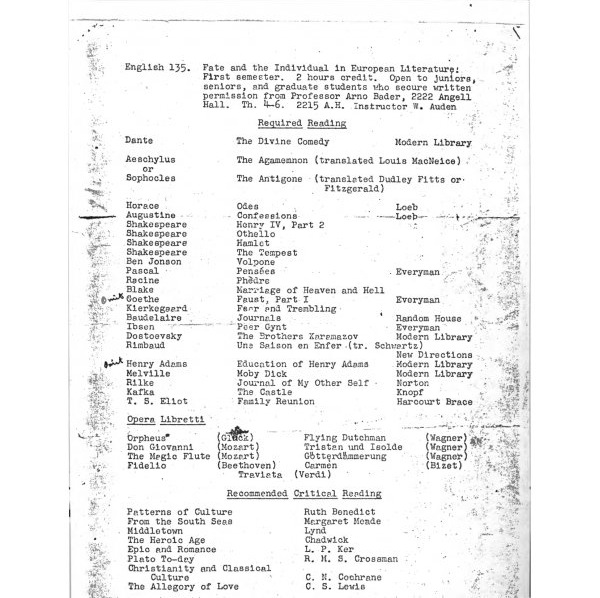
The first is that I have found myself increasingly overpowered by what I call in shorthand the “I do not understand Hegel” problem. The great theologians and philosophers of the not-too-distant past — and, still, the greatest in the present — were staggeringly, now almost incomprehensibly, literate and erudite figures. Before publishing his great work on hermeneutics, Gadamer was a noted expert on the pre-Socratics. Karl Barth is sometimes accused of not having read the tradition fairly, but he has never been accused of not having read it thoroughly. Brevard Childs seems to have truly read every book ever written. Part of what makes Hegel singularly difficult is, of course, his ruthlessly abstract and intensely tedious style; but no doubt another part is that very few people today are educated the way that he and his peers were. Take a slightly more recent example: what man of letters teaching at the University of Michigan today would dare assign his undergraduate students a reading list like W. H. Auden’s? If philosophy and theology are the Great Conversation, one must learn to discern and hear the enduring presence of the older voices who have left the room before one can truly contribute or at least understand.
The second is that, despite the immensity of my to-read list and the paucity of my already-read list, I do feel that I reached an inflection point with the turning of the year. That was when I finished reading Karl Barth’s Protestant Theology in the Nineteenth Century — the bulk of which is actually about eighteenth-century philosophy and theology as the “background” to nineteenth-century theology; and it must be said that Barth appears to enjoy writing about Rousseau, Kant, Hegel, and so forth a great deal more than the nineteenth-century theologians who are the book’s ostensible subject — and an unofficial trilogy by Lesslie Newbigin: Proper Confidence, Foolishness to the Greeks, and The Gospel in a Pluralist Society. These, somehow, coordinate in my mind: Barth and Newbigin (who was, not coincidentally, heavily influenced by Barth) together outline the negative space for and sketch the positive content of the properly Christian post-liberal synthesis which we desperately need — or which, at any rate, I need in order to feel intellectually satisfied. In the coming months, as the intellectual dust from my aforementioned reading settles, I may take a few stabs at describing what seem the chief features of that synthesis. But I also sense, if dimly, that in order to know what I really mean by those features, I will need some more pre-modern context and contrast. I can thus leave Barth and Newbigin for a little while, confident that I will return to them better able to understand what is fruitful in what they offer.
It is high time, then, that I actually read Plato and Aristotle (not to mention Seneca and Plotinus); that I (begin to) read through the Church Fathers; that I revisit Homer (and meet Vergil anew). I am doing so as follows. For Plato, I have launched into the Ukemi Audio series dramatizing the Socratic dialogues (in Benjamin Jowett’s translation), with the astounding David Rintoul as an unforgettable Socrates — and intend to write here, for my own benefit, at least a short reflection on each dialogue. For the Fathers, the obvious place to start is Volume I of the old Schaff set, with Sts. Ignatius, Justin, Irenaeus, and their comrades. With the Iliad, which I have at least read before (perhaps more than a decade ago), I have cracked open Emily Wilson’s recent translation. In none of these cases is the point a deep, doctoral-seminar level understanding. Rather, the point is familiarity, breadth, and fresh inspiration: to drink deep from the old and honored wells.
If [you have quoted this passage] because you imagined that you could throw doubt on the [preceding] passage, in order that I might say the Scriptures contradicted each other, you have erred. But I shall not venture to suppose or to say such a thing; and if a Scripture which appears to be of such a kind be brought forward, and if there be a pretext that it is contrary, since I am entirely convinced that no Scripture contradicts another, I shall admit rather that I do not understand what is recorded, and shall strive to persuade those who imagine that the Scriptures are contradictory, to be rather of the same opinion as myself.
— St. Justin Martyr, Dialogue with Trypho 65 (in The Ante-Nicene Fathers, Vol. 1).
My reading project on the concept of tradition commences in earnest with Origen’s De Principiis (I use John Behr’s translation, with minor punctuation and formatting alterations):
All who believe and are assured that “Grace and truth came through Jesus Christ,” and who know Christ to be the truth, according to his saying, “I am the truth,” derive the knowledge which leads human beings to live a good and blessed life from no other source than from the very words and teaching of Christ. And by “the words of Christ” we mean not only those which he spoke when he became human and dwelt in the flesh; for even before this, Christ, the Word of God, was in Moses and the prophets… And that he also spoke, after his ascension into heaven, in his apostles, is shown by Paul in this way, “Or do you seek a proof of Christ who speaks in me?” [Pr.1.]
Since, however, many of those who profess to believe in Christ differ not only in small and trivial matters, but even on great and important matters — such as concerning God or the Lord Jesus Christ or the Holy Spirit, and not only regarding these but also regarding matters concerning created beings, that is, the dominions and the holy powers — it seems necessary first of all to lay down a definite line and clear rule [Gk Vorlage: kanon?] regarding each one of these matters, and then thereafter to investigate other matters. … [Although] there are many who think that they know what are the teachings of Christ, and not a few of them think differently from those before them, one must guard the ecclesiastical preaching, handed down from the apostles through the order of succession and remaining in the churches to the present: that alone is to be believed to be the truth which differs in no way from the ecclesiastical and apostolic tradition. [Pr.2.]
[The] holy apostles, in preaching the faith of Christ, delivered with utmost clarity to all believers, even to those who seemed somewhat dull in the investigation of divine knowledge, certain points that they believed to be necessary, leaving, however, the grounds of their statements to be inquired into by those who should merit the excellent gifts of the Spirit and especially by those who should receive from the Holy Spirit himself the grace of language, wisdom, and knowledge; while on other points they stated that things were so, keeping silence about how or whence they are, certainly so that the more diligent of their successors, being lovers of wisdom… might have an exercise on which they might display the fruit of their ability. [Pr.3.]
A rich, and pointed, passage by Sertillanges on the intellectual’s need to be solitary but not isolated:
[Do] not forget that in association with others, even in ordinary everyday meetings, there is something to be gleaned. Too much solitude would impoverish you. … [You] must feel that you cannot shut yourself up entirely. Monks themselves do not do it. You must keep, in view of your work, the sense of the common soul, of life, and how could you have it if, cutting yourself off from human beings, you had in mind but a dream-humanity? The man who is too isolated grows timid, abstracted, a little odd: he stumbles along amid realities like a sailor who has just come off his ship; he has lost the sense of the human lot; he seems to look upon you as if you were a “proposition” to be inserted in a syllogism, or an example to be put down in a notebook. In the inexhaustible wealth of the real, too, we can find much to learn; we must move in it in a spirit of contemplation, not keep away from it.
— A. G. Sertillanges, The Intellectual Life: Its Spirit, Condtitions, Methods, 59. “The inexhaustible wealth of the real”: what a marvelous phrase.
Subject for further reflection: Christ’s encounter with His two disciples on the road to Emmaus gives the paradigm for our worship. First, as they walk, Christ expounds Moses and the Prophets, “opening their minds” to understand how the Scriptures show it necessary “that the Christ should first suffer and then enter into glory.” Then, as they sit down to supper (“Stay with us!”), the Lord “opens their eyes” in blessing and breaking the bread, and they learn Who it was that unfolded the Scriptures to them: “Did not our hearts burn within us…?” The order is always thus: Hearing ushers us on to seeing; the Word guides us to the Table; the Scripture prepares us for Eucharist.
A ChatGPT query requires roughly 5x the electricity of a normal Google search — that is, a Google search from the days before Google’s “AI Overview” itself 5xed the energy use of every single Google search you perform. If this is the case for a purely text-based response, I don’t even want to know how much energy an image or video generator like DALL-E — or a “music” generator like Sora — requires per query.
Furthermore, LLM chatbots — due to both their design and their inefficiency in completing the tasks for which they are designed — invite far more queries per day than your typical search engine. The teenagers who spend hours a day chatting with their LLM “therapists” or “AI girlfriends” may be the high tail of the bell curve, but there is no doubt that they are living right into the technology’s basic affordance. I challenge anyone to find a large number of people who literally spend all day Googling things (well, okay, actually, I do know at least one person like this). OpenAI wants everyone to use GPT-4o for everything, 24/7.
To keep up with this insane and constantly-escalating scale of usage (think also of how every shopping website is suddenly integrating an AI-powered helper chatbot!), new data centers are being constructed every single day. Worldwide data center energy use probably doubled between 2022 and 2023, probably due in substantial part to the impact of rolling out generative AI tools, and seems on pace to keep doubling annually (in a sickening update to Moore’s Law).
Note also that server farms and data centers are frequently built in regions like the American West which have plenty of available land but scarce water resources. In energy economics, there is a well-known tradeoff known as the “water-energy nexus:” the more water you are able to use (mostly for cooling), the less energy you have to use, and vice versa. In other words, there is ecologically no such thing as a free lunch: degrade your local ecosystem through water use, or pump carbon dioxide and other more noxious pollutants into the air somewhere else. Furthermore, by all accounts data centers significantly degrade quality of life and health outcomes (through, fascinatingly, steady noise pollution in both audible and inaudible frequency bands) for the people who are misfortunate enough to live near them.
The easiest technologies to eliminate from the economy are, by definition, the ones which have not been integrated into the economy yet. Unlike the automobile, industrial agriculture, air travel, and the other technological revolutions to which we are constantly hearing “AI” compared, the “AI revolution” has not happened yet. It is incredibly unpopular — the American public views “AI” with something like 70% unfavorability the last time I looked into it, which is more unpopular than Donald Trump was at any point during his first term in office — and consistently becomes more unpopular as people learn more about it and have more experience with it. So why not simply say, with Bartleby the Scrivener, “I would prefer not to”? If you want to be serious about climate change, ban AI.
This, of course, will not actually happen. For one thing, it might not be legal (and certainly would not be legally practical) for, say, the US government to ban generative “AI” development. For another, all the incentive structures are aligned against it. To simply “not develop AI” is, clearly, a step that no currently existing tech company (and many not-yet-existing tech companies as well) is willing to countenance, for fear that they will be left behind by their AI-developing competitors — a classic race-to-the-bottom collective action problem. The incoming administration is filled with unapologetic cryptocurrency boosters (another infamously environmentally degradatory technology). And I should pause to say that I don’t quite wish to launch a Butlerian Jihad against all “AI” tools — I am very optimistic, for instance, about the improvements to weather forecasting which the new AI-based models seem to provide when used in conjunction with traditional computational physics-based models, and if AI tools can effectively replace human content moderators to keep porn off social media, all the better.
It’s also true that ending “AI” development would not come anywhere close to reversing anthropogenic climate change. Automobiles, industrial agriculture, and air travel are far larger contributors still to the problem, and there is no good replacement for fossil fuels in these domains (electric car boosters to the contrary). It is impossible to avoid the truism that if you want 18th-century emissions, you need an 18th-century lifestyle. Nobody in the 21st century is going to voluntarily revert to an 18th century lifestyle. What we need, rather, is a massive and non-fossil fuel source of energy that could not only, say, power AI, but also make planetary-scale carbon capture & storage economically viable. No solar or wind power technology is capable of providing this, for reasons of basic physics, and the ecological costs of resource extraction to make solar panels and their battery packs are so significant that it is not clear to me a solar panel will ever, environmentally speaking, “pay for itself” in emissions reductions. Hydropower sounds great if you have a massive river nearby (not the case everywhere!), but every time we check in on the maintenance requirements and ecological impacts of dams, the answer gets worse and worse. That is why I consider it enormously telling that AI developers such as Microsoft, recognizing that the new product they are shoving down all our throats requires an astounding quantity of energy which the current American grid is simply not ready to provide, are making quiet but massive investments in the future of nuclear energy.
The real proposal, then, might actually turn out to be: anthropogenic climate change, widespread generative “AI”, new nuclear energy — pick two.
Questions the “historical method” might ask about the “laws of leprosy” in Leviticus 13–14: What was this disease, actually? The same as what we know as “leprosy” today or different? Multiple diseases? Surely the same pathogen does not affect humans and garments and structures — are these different sorts of molds? What is the cultural logic of hygiene that generates these regulations?
Questions a literary-theological approach might ask: Why is the leper who is “covered head to toe” in his disease pronounced clean? Why must the unclean leper dwell outside the camp? Why are the defilements of skin, fabric, and structure all referred to as “leprosy”? Why is the cleansing of leprosy accomplished through a sin offering and a burnt offering? What exactly is being “cleansed”? Why does it require a full-body shaving? What are the analogies between humans and houses? The significance of clean garments? How can one make atonement for a house?
Imperial conquest — or “national” unification by force, which is hardly so different — requires first that the army be restructured to be highly legible and loyal to the State, rather than organized according to local customs and loyal to their own localities; then that the government of the empire (or nation) be remade in the image of the army; then, finally, that local society be remade in the image of the government.
Any institution, movement, or ideology that appeals to the priors of wealthy, successful, and powerful men and women — especially those who (or whose families) have attained wealth, success, or power via success in business — will, as a rule, be surpassingly better funded than any institution, movement, or ideology that questions, undermines, or contravenes those priors.
Success in business, while (in most cases) requiring the development of certain skills and capabilities which bear resemblance to (and may even participate in) important virtues, is not domain-transferable. It offers absolutely no credit or guarantee that the model successfully used — or the businessman or woman who achieved that success — is in any way applicable outside of business.
Indeed, success in business may indeed blind the successful to their need for the virtues which enable “success” in other fields of life, by leading them to assume that those fields of life all work on roughly the same principles as the business world. Success in business may thus, absent a deep and thorough process of virtue-formation which cannot originate from or primarily take place in the business world, produce wealthy, successful, and powerful men and women who radically lack insight into what is truth.
The support, or lack thereof, of the wealthy, successful, and power for an institution, movement, or ideology therefore has absolutely nothing to do with the truth of such an institution, movement, or ideology’s core commitments or doctrines. Not only is there definitively no causal relation; there is no necessary correlation whatsoever.
It is almost defensible, as a result, to say that if one wishes to find truth in an institution, movement, or ideology, one should begin by looking as far as possible from where the wealthy, successful, and powerful congregate — and donate.
this post brought to you partly by a reading of Plato’s Gorgias and Protagoras