I was asked the other day to explain my habitual use of the honorific “St.” — e.g., St. Paul, St. Augustine (of Hippo) — as a Protestant. (Asked, to be clear, in a non-hostile way!) Here is my response, edited and expanded from its original format.
Normally, in practice, I use that honorific for those recognized as saints in the pre-Reformation Latin church. The main group are those who are saints of the ecumenical or undivided church — the apostles (St. Paul), the early martyrs (Sts. Perpetua and Felicitas), the fathers (St. Augustine of Hippo) and mothers (St. Macrina the Younger) of the church, and so forth. The Anglican Communion also recognizes as saints a number of medieval Latin figures (St. Thomas Aquinas), inherited at the time of the break with Rome. By contrast, I think I do not normally speak of anyone post-Reformation as St. so-and-so — though if discussing someone who, while not so recognized by the Anglican Communion, is reckoned a saint by Rome or the Eastern churches, and the case for whose saintliness seems eminently reasonable, I would probably use it out of respect (e.g., St. Thérèse of Lisieux).
Of course, all of us in the Christian churches are “saints” in the dialectical Pauline sense — “sanctified, called to be saints.” When I speak of “the saints” I normally have this group in mind. But along with this understanding the church has, always and purely retrospectively, recognized certain men and women in Christian history as having been friends and servants of Christ in a distinctively discernible way. In service of our own life of imitating and being conformed to Christ, they are worthy of learning from, studying, and even in a limited sense imitating (in the degree that they themselves were faithful imitators of Christ). This is a sub-species, essentially, of having strong Christian friends: since I really am something like the weighted average of the five people with whom I spend the most time, should I not spend substantial time with those whose lives most strongly testify to the power of Christ at work in them? Not, of course, that this means the marginalization or exclusion of spending time in prayer and Bible reading, i.e., spending time with Christ Himself — the point is that these influences do not compete or even operate on the same plane. The church’s recognition of these men and women, and special use of the term “saint” for them to denote that in their own individual ways they were (are!) what we all are called and being reshaped to be, seems perfectly appropriate. In this sense, the use of “St.” is a way of disciplining my speech to obey the fifth commandment: honoring my fathers and mothers in the faith.
Now, as far as I can tell, the characteristic spirit of the saint is summed up by St. John the Baptist: “He must increase, and I must decrease.” The saints are to be honored as paradigmatic imitators of Christ, not worshipped as Christ Himself. In church history there are many ways that it seems clear to me that the honor due the saints has been at minimum over-extrapolated and at maximum blasphemously elevated. I am hardly unaware of them, and am wary of these accretions and abuses in the degree that seems to me appropriate in each case. Take as an example the practice of asking the saints for their prayers. A simple form of this is, I take it, perfectly unobjectionable and even reasonable in itself: the saints, we confess, are not dead but alive in Christ (cf. Matt. 19), and certainly no Protestant would (or should) object to asking your friends to pray for you or join you in your prayers. But in certain quarters this is expanded into the notion that one should ask the saints for their intercession rather than Christ for His, because Christ is far off and unapproachable whereas the saints are gentle and friendly, and their closeness to the throne guarantees one’s prayers a better hearing. To this I must say Nein! There is one mediator between God and humanity: the man Christ Jesus. Through Christ (who dwells in our hearts by faith) we have access to the Father — not, through the saints who dwell in our hearts by faith we have access to Christ and thus to the Father. (And so on and so forth with the standard and correct Protestant rebuttal texts.) The sole mediacy of Christ is not to be compromised for the sake of showing his friends pious respect. I suspect the saints themselves, with their fully redeemed vision of Christ, would shudder at this notion!
Nevertheless, I also take abusus non tollit usum to be an essential principle of the spiritual life. Nothing, be it ever so holy by God’s grace, that makes contact with and exists within the fallenness of this world is proof against abuse: not the words of Scripture, not the sacraments, not the Church’s authority to bind and loose. (I take this to be one of the core insights and impulses of Protestantism — which is why I am content to remain one.) This does not degrade Scripture’s holiness, the sacraments’ efficacy, the keys’ power. God’s persistent business throughout the history of humanity appears to be working for good what we meant, ever so misguidedly, for evil.
This leads to a larger question of theological taxonomy: What is the nature and authority of the tradition (for a tradition it eminently is) that is the recognition of saints? I would place it in a tertiary and subsidiary category. It belongs to the tradition as a guide to the right understanding of church history, not even principally to the right understanding of Scripture. This requires some exposition of my take on the relevant categories.
The primary, and in that sense sole, authority is Holy Scripture, which stands alone. No two-source theories here. Let me be clear: Scripture is a traditioned thing. It does not, and makes no pretensions to, fall from the sky complete (presumably in the King’s English), nor does it purport to have been dictated to its human authors such that it is in principle untranslatable (unlike the Quran). God gives it through, alongside, and for the normal processes and procedures of human existence and experience. The difference is that it is recognized by the eyes and ears of faith — the community of faith — as being no mere human word but as really being the Word of God, the words for which God takes definitive responsibility. This is confirmed to us in the birth, life, death, resurrection, and ascension of Christ Jesus — all of which take place, in the richest possible sense, “in accordance with the Scriptures.” For this reason the communities that received the Word, in generation after generation, thought it necessary to make it a textually fixed thing: not so that it could be a “dead letter” but so that it could be, for all subsequent generations, “living and active,” that every day, as long as it is called “today,” the Word could speak its own independent “today.”
The secondary category, then, contains those traditions that belong to the rule of faith: they are the boundary markers of the Church catholic as being (in Webster’s phrase) the domain of the Word. The rule of faith is not Scripture, but to read Scripture in contravention of the rule of faith is to cease to interpret the Scripture as part of the Church, and (as Scripture testifies) there is only one Church. The nature of its authority is that it is handed down along with Scripture to orient us rightly to Scripture, ruling out certain readings (and the practices that depend on them) and ruling in others. Its authority is dependent on Scripture’s precisely because it appeals constantly and ultimately to the revelation of God revealed in Scripture through the mind and work of the prophets and apostles. Within this framework, there is an obvious need for elements that are not themselves Scripture but are commentary upon it. So the traditional catechism contains the Apostles’ Creed alongside the Decalogue and the Lord’s Prayer because it is the ancient baptismal confession. Similarly the creeds and conciliar judgments of the undivided church lie in this category. Abandon them and, well, God might not abandon you — He is notoriously and scandalously gracious — but you abandon the Church. They are in this sense articles of faith.
The tertiary category is really a subsidiary category of tradition: traditions that are venerable but do not belong to the rule of faith. This includes many liturgical practices like the sign of the cross, kneeling for confession, appending the antiphon Gloria Patri to the Psalms and the refrain “The Word of the Lord / Thanks be to God!” to other readings of Scripture, and the honorific “St.”. Many of these are, or grow out of, genuinely ancient practices — Tertullian speaks of the signing with the cross in the early third century, and in their writings the Fathers are always saying things like “as the most blessed and holy Cyril writes…” which is a logical precursor to calling him “St. Cyril.” The point is that they are distinctive disciplines of speech, thought, and gesture. When I pray a Psalm or read a portion of Scripture, especially one whose words make me uncomfortable, it is good for me to end by reminding myself of the divine origin and purposes of the Biblical text. When I am speaking words that remind me (often against my instinctive will) of my sinfulness and implore God to have mercy on me, it is good to adopt a bodily posture that accords with this self-humiliation. I am very happy to adopt and submit myself to such practices, especially under the guidance of my church as it adopts them. But they are at most expressions of belonging to the catholic tradition, not themselves definitive markers of that tradition’s boundaries.
Finally, there is obviously much disagreement — even within the large and unruly Protestant camp — over the boundaries between these categories. I cannot hope to resolve it here, only to sketch my own present view of these matters. As the above discussion indicates, I have little interest in — or envy of — a magisterium that would permanently render all such judgments for me. (As the life of the current Christian body ostensibly ruled by a magisterium indicates, it actually does not in practice.) This is because the Bible, and the church’s proclamation that seeks to think the Bible’s thoughts after it, do not seem meant to give us an exhaustive manual for responding correctly to life’s problems and questions. The Bible would look very different if it were (more like, say, the Quran and the Hadith in Islam). Instead, Bible, proclamation, and tradition are together all meant to make us wise for, and regarding, the salvation that is in Christ Jesus (2 Tim. 3:15).
A fantastic essay from Zac Koons, including this stellar line: “The rapid creep of AI into every nook and cranny of life represents a golden opportunity for our churches to grow and flourish. All we have to do is not use it.”
In the dogmatic and theological history of every age, not excluding that of Protestantism, secular factors have played a part which tends to cover over all else. For all the gloating with which it was done, it was a good thing that the work of Pietism and the Enlightenment in Church History established so incontrovertibly the fact that even in such periods of supreme decision as that in which the dogma of the Trinity arose the history of the Church was anything but a history of heroes and saints. Yet in this case we should be just and perceptive and allow that not only the Church of Byzantium but also that of Wittenberg and Geneva, and finally the purest Church of any of the quiet in the land, have always and everywhere been, when examined at close range, centres of frailties and scandals of every kind, and that on the basis of the Reformation doctrine of justification at all events it is neither fitting nor worth while to play off the worldliness of the Church against the seriousness of the insights it has perhaps gained in spite of and in this worldliness. The same may be said about the indisputable connexion of the dogma with the philosophy of the age. By proving philosophical involvement we can reject the confessions and theology of any age and school, and we can do this the more effectively the less we see the beam in our own eye. For linguistically theologians have always depended on some philosophy and linguistically they always will. But instead of getting Pharisaically indignant about this and consigning whole periods to the limbo of a philosophy that is supposed to deny the Gospel—simply because our own philosophy is different—it is better to stick strictly to the one question what the theologians of the earlier period were really trying to say in the vocabulary of their philosophy. Caution is especially demanded when we insist on differences in the so-called piety of different periods and therefore claim that the piety out of which the dogma of the Trinity arose was completely different from our own piety with its sober focus, as they said some years ago, on “worldview and morality.” What right have we to regard our own piety, even if its agreement with the Reformation and the New Testament seem ever so impeccable, as the only piety that is possible in the Church, and therefore to exalt it as a standard by which to measure the insights of past ages? Let us be sure of our own cause so far as we can. But antithetical rigidity especially in evaluating the subjective religion of others is something against which we can only issue a warning.
The superscription of Psalm 51 links that most famous and gut-wrenching of repentance Psalms directly to David’s sin concerning Bathsheba and Uriah. Verses 1–17 are relentlessly first-person singular, with one English translation containing thirty-two instances of I, me, my, and so forth. Verse 4, “Against you, you only, have I sinned, and done what is evil in your sight” — a stumbling block for contemporary readers, who are here inclined to wonder, “Hasn’t David sinned against Bathsheba and Uriah, too?” — represents a radical narrowing of focus such that David’s sin is, at least for the moment of this Psalm, entirely viewed from within a single I-Thou relation. David reflects that God “will not be delighted in sacrifice, or I would give it; you will not be pleased with a burnt offering.” Rather, “a broken and a contrite heart, O God, you will not despise.” (He has learned well the lesson which his predecessor failed to grasp.)
Then the Psalm concludes on a completely different note, seemingly in a completely different voice: “Do good to Zion in your good pleasure; build up the walls of Jerusalem; then will you delight in right sacrifices, in burnt offerings and whole burnt offerings; then bulls will be offered on your altar.” What is the deal?
I am not usually one for speculative text-critical historical reconstructions, but in this case these last two verses (18–19 in ETs) sure seem like a later supplementation to an originally shorter text. And if that is the case, it must be said that the editors have not tried very hard to disguise the addition. There is no attempt to inhabit David’s point of view, or even make many explicit verbal links. Indeed, the underlying plot of the appendix seems quite different than the underlying plot of the main Psalm. So one wonders if the discontinuity is, in fact, the point. The “seam” in the text draws the attentive reader’s eye, and sets him or her thinking on how one tragic situation — David’s adultery with (and abuse of power over) Bathsheba, compounded by his murder of Uriah — may illustrate, elucidate, or analogize the situation of Israel’s idolatry and subsequent destruction. One might hear, in the plea to “build up the walls of Jerusalem,” an echo of the post-exilic situation of Ezra and Nehemiah, in which right sacrifices have long ceased because the Temple and the walls have been destroyed. I imagine there are many fruitful connections to draw.
This leads me to one further point of canonical interest. Many of the Prophets (Hosea, Jeremiah, and Ezekiel in particular) develop the metaphor of Israel as God’s unfaithful wife, with the exile coming as long-overdue punishment for her adultery. If I am right that in the appendix to Psalm 51 we are to hear a correlation with the exile, with David standing for sinful and punished Israel, this is one of the only examples I can think of in which the Biblical commentary on the exile flips that gendered dynamic. Instead of a (variously) promiscuous or easily-seduced woman, Israel is here cast as — in the person of David — an abusive, murderous man.
When one prays repeatedly through the Psalter in sequence, one tends to start noticing patterns in how the Psalms are arranged, or at least suspecting characteristic editorial strategies. The set of Psalms for Evening Prayer on the 28th of the month — 136, 137, 138 — exemplifies one of those strategies: what I think of as the containment of imprecation.
Psalm 137 is perhaps among the most famous of Psalms: “By the waters of Babylon, we sat down and wept, when we remembered Zion,” it opens. We are in the immediate aftermath of the exile from Judah, with the grief still raw, the horror still fresh. “On the willows there we hung up our lyres. For there our captors required of us songs, and our tormentors mirth, saying, ‘Sing us one of the songs of Zion!’ How shall we sing the Lord’s song in a foreign land?” Then the Psalm goes on in progressively darker tones, with (interestingly) two sets of imprecations. First is the less famous double self-imprecation, enjoining the singer not to forget Zion — “If I forget you, O Jerusalem, let my right hand forget its skill; let my tongue stick to the roof of my mouth, if I do not set Jerusalem above my highest joy!” Only then follows a double imprecation against Judah’s enemies. The singers urge the Lord to remember Edom’s complicity in the “day of Jerusalem, how they said ‘Lay it bare, lay it bare, down to its foundations!”, before concluding with the most notorious passage: “O daughter of Babylon, doomed to be destroyed, blessed shall he be who repays you with what you have done to us! Blessed shall he be who takes your little ones and dashes them against the rock!”
There is a lot going on here, even just within the Psalm itself. For starters, the final imprecation — certainly as violent as anything in the entire Bible — is, strictly speaking, not a curse, but a blessing. It performs a complexly layered speech act: 1) pronouncing a (future and hypothetical) blessing on conquering soldiers who will dash Babylonian infants against the rock, which in turn 2a) reveals to the reader, and 2b) reminds the singer, just what the Babylonian soldiers themselves did when they conquered Jerusalem; thus 3) entreating the Lord to mete out his retributive justice (as the previous clause makes clear: “who repays you with what you have done to us”), and only after and through those layers 4) wishing for the violent destruction of the singers’ enemies. This violent pitch is also only reached after the singers have recalled their mockery by their captors (“Sing us one of the songs of Zion!”), and their betrayal by Brother Edom (“Lay it bare!”). None of this makes, or should make, the final sentence itself “easier” to read (or pray), but it does (in a certain literary sense) contain the scope and import of the curse, and illuminates the deep emotional complexity and psychological honesty of the Psalter.
Now observe how the editors of the Psalter contextualize and contain this imprecatory outburst by placing it between Psalms 136 and 138. Psalm 136, first: this is surely among the most uncomplicatedly celebratory Psalms, with its recounting of the Lord’s “great wonders” punctuated by the response “His steadfast love endures forever.” These “great wonders” are, first, the orderly creation of heavens, earth, and waters, and the lights that rule over them; second, the deliverance of the elect nation in the Exodus, their protection through the wilderness (“To him who struck down great kings…”), and their conveyance into the promised land. (There is just the merest hint of Judges-style post-conquest troubles: “It is he who remembered us in our low estate… and rescued us from our foes”.) There is no explicit mention of Jerusalem, but the narrative setting is — at least imaginatively — before exile. And if that is implicit in Psalm 136, it is made explicit in the tightly linked Psalm 135, which concludes in Jerusalem herself: “Blessed be the Lord from Zion, he who dwells in Jerusalem! Praise the Lord!” For that matter, the whole sequence Psalms 120–134 are the “Psalms of Ascent,” sung by pilgrims on their way to the festivals in Jerusalem, renarrating the long journey from “the tents of Kedar” (120:5) to “the house of the Lord” (134:1). The Psalms which precede 137 are, quite literally, “the songs of Zion” demanded by the Judahites’ Babylonian captors.
Meanwhile, in Psalm 138, we are in a tonally somewhat different world than 136 (as well as temporally different, per the superscription “of David”). It is undoubtedly a Psalm of thanksgiving, but the exuberance is tempered by recent suffering and deliverance: “On the day I called, you answered me… Though I walk in the midst of trouble, you preserve my life; you stretch out your hand against the wrath of my enemies, and your right hand delivers me.” Nevertheless, there is at least one indubitable link to 136: that Psalm’s refrain appears again in David’s concluding lines, “The Lord will fulfill his purpose for me; your steadfast love, O Lord, endures forever” — before the somewhat open-ended “Do not forsake the work of your hands.” (The refrain is thus modulated, perhaps, into an injunction that the Lord should be mindful of his own nature and remain faithful to his covenant!) Less overt, but still clear, links to 136 include “all the kings of the earth” giving thanks to the Lord (recalling, by contrast, the kings who were struck down); “though the Lord is high, he regards the lowly” (recalling the Lord remembering Israel “in our low estate”); and, perhaps more speculatively, “before the gods I sing your praise” (recalling the “great lights” created to rule over the day and the night). And our note that (at least) 134–136 are among “the songs of Zion” draws attention to the liturgical setting of 138: “I bow down toward your holy temple and give thanks…”
So what were the editors of the Psalter thinking in placing 137, the paradigmatic Psalm of grief and rage at Jerusalem’s destruction, between 136 and 138, two Psalms of rejoicing in Jerusalem? I suggest that it is purposeful, and strikingly psychologically insightful. They have put grief and rage — and yes, imprecation — in its proper place. The exiles’ anger is given its full venting, as it must be. The sheer horror of violence against the innocent, compounded in the destroying victors’ demonic mockery, must be recalled, and these must continually shock to the point of outrage. There is to be no naïvety. Evil must have its due, and — when revealed for what it truly is — what it is due truly is cursing. But precisely as — and because — the curse is offered up to God, it is given over to God. It is made His responsibility (“Do not forsake the work of your hands”). And as it is made His responsibility, it is contained. It is put into the context of God’s creative and saving blessing. In fact, it only acquires its force from the fact of His creative and saving blessing. And by that same fact the curse is given its definite limitations, limitations which are notably not placed upon the blessing. The imprecation is not allowed to devour the Psalmist from the inside, but it is released; better still, the Psalmist is released from it, to the joy of God’s abundant blessing. Sin always crouches at the door of imprecation, but in offering the imprecation as prayer, the Psalmist masters it.
So the curse is put in its place, and thus we are promised that the curse will not reign forever, but that blessing, having given way to curse, will one day be restored. This yields the larger narrative purpose in the Psalter, of which this psychological purpose is an icon. The sequence of Psalms 136–137–138 enacts in small the story of exile and return. As we read, we follow the Psalmists through time, from exuberant rejoicing through gutting anguish to renewed joy; we experience the dialectic of resonance and alienation; we know the presence of God even as we momentarily feel His absence; we trace what my teacher Jeremy Begbie describes as the movement of “home, away, and home again” — with the essential acknowledgement that home, when you do return, is never quite the same. We rehearse the pattern of the Lord’s faithfulness and steadfast love.
Or, in the words of that great Master Teacher of Scripture: “Was it not necessary that the Messiah should first suffer all these things, and then enter into his glory?”
The first sequence of feasts in Leviticus 23 — Passover/Unleavened Bread (vv. 4–8), Firstfruits Offering (vv. 9–14), and Weeks (vv. 15–21) — maps to the sequence of Christological events from Passion through Resurrection to Pentecost. The Gospels, and St. Paul (1 Cor. 5), of course spell out the Passover/Passion connection. But what I hadn’t noticed before is the Firstfruits Offering. This offering, less familiar perhaps than Passover and Unleavened Bread, is a wave offering of a single sheaf of the firstfruits (probably of the barley harvest) “that you may be accepted” (v. 11), and accompanied by an ascension offering of a male lamb a year old with (unleavened, of course) bread and wine (vv. 12–13). No bread may be consumed before this offering is brought (v. 14). And this offering takes place on “the day after the Sabbath” (v. 11) during Unleavened Bread: that is, on the first day of the week. On Resurrection Day — well, Christ rises as the firstfruits of those that had fallen asleep. Meanwhile, Weeks marks the ingathering of the firstfruits of the (probably wheat) harvest, seven weeks later; at Pentecost, the Spirit descends to gather in the firstfruits of the Church, harvested from all nations.
Is St. John the Evangelist subtly hinting that he was present at the very beginning of Christ’s ministry in John 1? John the Baptizer is “standing with two of his disciples” (v. 35) when the Lamb of God walks by, and the two follow Jesus. One is Andrew, the brother of Peter (v. 40), but the other goes unnamed. Is this the Evangelist? If so, it helps make sense of some of the curious features of John 1. The dramatic action of the gospel begins with the Baptizer’s confrontation with the Pharisees’ emissaries, which one of his disciples would have been well-positioned to observe. But perhaps more significantly, the Prologue — otherwise a carefully crafted poem about the Logos who was in the beginning with God, who was and is Light and Life, who came into the world and became flesh to dwell among us — contains two prima facie odd interjections about John the Baptizer: that he was sent from God as a witness about the light, but was not the Light himself (vv. 6–8), and a part of that testimony about the Light’s preeminence (v. 15). If the Evangelist initially had a life-altering encounter with the Baptizer such that he became one of his disciples, then subsequently encountered Jesus of Nazareth and was sent to follow him at the Baptizer’s behest — this all makes sense of why, in his old age, as he was giving final shape to his own testimony that Jesus is the Christ, the Son of God, he and his followers still could not do without the Baptizer’s testimony. (There is also a point about the historical particularity of the Word becoming flesh: remove the specifics of John the Baptizer that intrude upon the Prologue, and it could resemble a passage of Platonic speculative theology.)
The question is still haunting me: Why is there no New Covenantal analogue to the Feast of Booths? Is it because the temporary dwellings and tabernacles and temples of the Old Covenant, made by human hands, have received their fulfillment in the Word who became flesh and tabernacled among us, the new Temple not made by human hands?
[The] aim of that divine power, which bestowed upon us the sacred Scriptures, is that we should not accept what is presented by the letter alone — such things sometimes being not true with regard to the letter but actually irrational and impossible — and that certain things are interwoven with the narratives of things that happened and with the legislation that is useful according to the letter. But, that no one may suppose that we assert that, with respect to it all, none of the narratives actually happened, because a certain part did not; [or] that none of the legislation is to be observed according to the letter, because a certain part is irrational or impossible according to the letter; or that what is written about the Savior is not true on the perceptible level, or that no legislation of this or commandment is to be kept: it must be said that regarding certain things it is perfectly clear that the detail of the narrative is true… [and] the passages that are true on the level of the narrative are much more numerous than those which are woven with a purely spiritual meaning. (4.3.4)
Nevertheless, the precise reader will be torn regarding certain points, being unable to show without lengthy investigation whether the supposed narrative happened according to the letter or not, and whether the letter of the legislation is to be observed or not. Therefore one who reads in an exact manner must, observing the Savior’s injunction which says “Search the Scriptures,” carefully ascertain where the meaning according to the letter is true and where it is impossible, and as far as possible trace out, by means of similar expressions, the sense, scattered throughout Scripture, of that which is impossible according to the letter. When, then, as will be clear to those who read, the connection taken according to the letter is impossible, yet the principal is not impossible but even true, one must endeavor to grasp the whole sense, which spiritually connects the account of things impossible according to the letter to things not only not impossible but even true according to the narrative, with as many things as did not happen according to the letter being taken allegorically. For our position is that with respect to the whole of the divine Scripture all of it has a spiritual meaning, but not all of it has a bodily meaning, for there are many places where the bodily is proved to be impossible. And therefore great attention must be given by the careful reader to the divine books, as being divine writings… (4.3.5)
For “the kingdom of heaven is like a treasure hidden in a field, which someone found and hid, and then in his joy he goes and sells all that he has and buys that field”. Let us consider whether the apparent and superficial and surface aspect of Scripture is not the field as a whole, full of all kinds of plants, while the things lying in it and not seen by all, but as if buried under the visible plants, are “the hidden treasures of wisdom and knowledge” — which the Spirit through Isaiah calls “dark and invisible and hidden” — needing, for them to be found, God, who alone is able “to break in pieces the doors of bronze” that hide them and “to break the iron bars” that are upon the gates… (4.3.11)
But let it be sufficient for us in all these matters to conform our mind to the rule of piety and to think of the words of the Holy Spirit in this way: that the text shines, not because composed according to the eloquence of human fragility, but because, as it is written, “all the glory of the King is within,” and the treasure of divine meanings is contained enclosed within the frail vessel of the common letter. … (4.3.14)
Let everyone, then, who cares for truth be little concerned about names and words, since in every nation different usages of words prevail; but let him attend, rather, to that which is signified rather than the nature of the words by which it is signified, especially in matters of such importance and dignity… [for] there are certain things the significance of which cannot be adequately explained at all by any words of human language, but which are made clear more through simple apprehension than by any properties of words. Under this rule must be brought also the understanding of the divine writings, so that what is said may not be assessed by the lowliness of the language, but by the divinity of the Holy Spirit, who inspired them to be written. (4.3.15)
— Origen of Alexandria, On First Principles, tr. John Behr (Oxford University Press, 2019). I have introduced minor repunctuation in certain places for clarity.
The Gospel always says: Yes, then No, and then Yes again — and Amen.
Yes. Christ wants you: you, exactly as you are, as who and what you are. What Christ wants is no less than everything you are and have. He wants the whole of you because He loves you: He loves you because He made you, and He made you because He loves you. There is nothing in you that prevents you from coming to Him. There is no better or worse time, no more or less fitting state. Whenever it is called “Today,” if you hear His voice, the command is the same: “Follow Me.”
No. What this means is that when you come, you cannot offer anything more than the whole of yourself, in simple, complete, and undivided submission. You contribute nothing yourself, for what do you have that you did not receive? No part of what you now are is worthy as it is. Nothing can remain unchanged about your life or within your being. There is no power within you, no performance you could deliver, no height of virtue you could reach, which could make up the difference between what you are and what you would need to be: it is not a finite quantitative lack, but an infinite qualitative difference.
Yes — and Amen. When you offer nothing less and more than the whole of yourself, Christ Himself will make you what you ought to be. He takes your sin and gives you his righteousness; he takes your heart of stone and gives in its place a heart of flesh. He removes the veil from your sight and teaches you the true spiritual law. He will instruct you in the way you should go, shine His lamp upon your path, and give strength to your weary feet. He will at first perfect your feeble efforts at obedience and in time give you full power to do His will. Only then you will know what it is to say, with the Apostle, “Indeed, I worked harder than anyone: yet not I, but the grace of God working within me.”
This morning in our Daily Office readings my wife and I reached Luke 8, which contains St. Luke’s account of the Parable of the Sower (parallels in Mt. 13 & Mk. 4):
(1) Soon afterward [Jesus] went on through cities and villages, proclaiming and bringing the good news of the kingdom of God. And the twelve were with him, (2) and also some women who had been healed of evil spirits and infirmities: Mary, called Magdalene, from whom seven demons had gone out, (3) and Joanna, the wife of Chuza, Herod’s household manager, and Susanna, and many others, who provided for them out of their means. (4) And when a great crowd was gathering and people from town after town came to him, he said in a parable, (5) “A sower went out to sow his seed. And as he sowed, some fell along the path and was trampled underfoot, and the birds of the air devoured it. (6) And some fell on the rock, and as it grew up, it withered away, because it had no moisture. (7) And some fell among thorns, and the thorns grew up with it and choked it. (8) And some fell into good soil and grew and yielded a hundredfold.” As he said these things, he called out, “He who has ears to hear, let him hear.”
(9) And when his disciples asked him what this parable meant, (10) he said, “To you it has been given to know the secrets of the kingdom of God, but for others they are in parables, so that ‘seeing they may not see, and hearing they may not understand.’ (11) Now the parable is this: The seed is the word of God. (12) The ones along the path are those who have heard; then the devil comes and takes away the word from their hearts, so that they may not believe and be saved. (13) And the ones on the rock are those who, when they hear the word, receive it with joy. But these have no root; they believe for a while, and in time of testing fall away. (14) And as for what fell among the thorns, they are those who hear, but as they go on their way they are choked by the cares and riches and pleasures of life, and their fruit does not mature. (15) As for that in the good soil, they are those who, hearing the word, hold it fast in an honest and good heart, and bear fruit with patience.
(16) “No one after lighting a lamp covers it with a jar or puts it under a bed, but puts it on a stand, so that those who enter may see the light. (17) For nothing is hidden that will not be made manifest, nor is anything secret that will not be known and come to light. (18) Take care then how you hear, for to the one who has, more will be given, and from the one who has not, even what he thinks that he has will be taken away.” (19) Then his mother and his brothers came to him, but they could not reach him because of the crowd. (20) And he was told, “Your mother and your brothers are standing outside, desiring to see you.” (21) But he answered them, “My mother and my brothers are those who hear the word of God and do it.”
St. Luke’s telling differs in various minor ways from St. Matthew’s or St. Mark’s, most notably the immediate context for the parable: he introduces it with the Lord “on the road,” as it were (Mt. and Mk. set it explicitly beside the lake), with his followers and supporters around him, and concludes it with the episode about the Lord’s “mother and brothers” (which in Mt. and Mk. immediately precedes the parable). This mild defamiliarization highlighted some non-obvious features of the parable, which in turn led me to what I think is a slightly unconventional interpretation. Essentially: this parable is not intended first to explain the individual’s response, but to illumine the community and context in which the individual responds.
Let me explain. The sower who sows the seed — which “is the word of God” (v. 11) — is, of course, Christ, who is going out “through cities and villages, proclaiming and bringing the good news of the kingdom of God” (v. 1). As he does so, Christ finds himself surrounded by “a great crowd” coming “from town after town” (v. 4). The parable is, then, a commentary on his (literarily) present actions. He is sowing the Word as he goes, in many different places, on many different soils. Now: the sown Word grows up into a plant (or, as in the first case, does not), which puts down roots in the soil — and the depth of the soil, and the other plants growing in that soil, determines whether the plants wither in the heat, fail to bear fruit, or grow healthfully and fruitfully. When Christ explains the parable, to what do the “plants” — the growths of the seed — correspond? They correspond to the persons who hear the Word. The most explicit indications of this are Christ’s references to their “roots” (v. 13) and “fruits” (vv. 14, 15). The plants are, as it were, “new growth” of the Word: new embodiments of the Word, which should themselves in the proper harvest time bear the seed of the Word, ready to be scattered anew by the sower. The growing Word-plant is a new life where previously there was none, a new-created person, which is to say a new kind of person. (Echoes of the psalm: “Blessed is the man… whose delight is in the Law of the Lord, and on His Word he meditates day and night; that man is like a tree, planted by streams of water, which yields its fruit in season and whose leaf does not wither.”) What, then, are the “soils”?
My suggestion is that the “soils” are not, primarily, different “types” of individual persons’ hearts and souls with their individual responses to the Word; rather, they are different sorts of communities with different kinds of environment for the Word-plantings. Think first about the nature of soil. Soil is not crude, inert matter on which a seed acts to extract water and nutrients. Soil is rather a rich micro-ecosystem, full of other living creatures, with hyper-locally varying tendencies and capacities and deficiencies, itself best understood as a kind of quasi-living substance. There is a dynamic relation — better, an indescribably complex array of dynamic relations — between the seed that is planted and the soil in which it is planted, even as they remain distinct from one another. So it is with the one who comes to believe the Word and the context in which he or she comes to believe it. Some “soils” offer only broad hostility, in which case the seed will struggle or fail to grow at all (“the devil comes and takes away the word,” v. 12). Other soils do not welcome a deep commitment, enforcing only shallow ones (“they receive it with joy… [but] in time of testing fall away,” v. 13). Many soils are full of entanglements and diversions for even a personally-committed believer (“they are choked by the cares and riches and pleasures of life, and their fruit does not mature,” v. 14). But some soil is good, not only permitting but encouraging deep, fruitful commitment (“they… hold it fast in an honest and good heart, and bear fruit with patience,” v. 15). In a rich, nourishing community, the new believer may put down deep roots and bear fruit a hundredfold.
Once we recognize that the primary correspondence is not between soil and believer, but soil and believer’s proximate environment, how much more, and broader, sense does this parable make of the life of faith! It was in a different context that St. Paul quoted the poet Menander to the effect that “Bad company corrupts good morals” (though it is a remarkable not-quite-coincidence that immediately after that quotation he discusses the nature of the resurrection body by analogy to seeds and plants; there are no coincidences in Holy Scripture!). But who has not seen a friend or acquaintance, ostensibly growing in faith, begin to wither when his closest friends begin expressing their disapproval of some teaching inherent to the faith? Or, even more commonly and tragically, whose faith has been slowly choked out when (say) she takes a high-paying job that relocates her away from her community, or when he begins dating someone who is attractive but has little interest in or commitment to faith? Which interpretation of the parable is more realistic (not to say compassionate): to say, “well, this just goes to show they were never good soil to begin with, you see”, or “alas that they were uprooted from good soil and planted elsewhere!” How psychologically realistic — brutally so — is this view of persons’ relation to their communities! Look at the findings of interpersonal neurobiology: I really am something like the weighted average of the five people with whom I spend most of my time. Who they are, and what sort of relation they have to the Sower, is naturally of critical importance for who I am. And in subtler but no less significant ways I am influenced by what a previous generation called my “station” in life, i.e., the cultural expectations endemic to my socio-economic layer: the sorts of media that People Like Me consume (and indeed the posture of “consumption”), the kinds of jobs we take, the places it is acceptable for us to live, the churches it is respectable for us to attend. This is the soil in which I live, and in which I am trying to grow. Of course it would affect how deep are my roots and how fulsome my fruits.
Note also that on this interpretation, the growth of the Word-seeds into living Word-plants at all is not only less a deterministic what-kind-of-soil-are-you? matter, but also more evidently due to the inscrutable, uncontrollable power of grace. Anyone who has sown seeds of any sort knows that, even in essentially the same soil, some of the seeds will grow well and others will not (indeed, probably only wealthy modern Westerners, in our highly sterilized environments and de-agriculturalized culture, can imagine crop growth to be basically a matter of controllable inputs and predictable outputs). Yes, there is a dynamic relation between the soil which permits and the seed which sprouts, but the priority is with the sowing of the seed and the actuality of the growth. So it is with the Word of God: whether an individual Word-seed, all else being equal, will indeed begin to grow into a Word-plant is decidedly inscrutable — at least to human understanding; I do not say inscrutable to God, for only God knows why a given human heart does or does not receive the Word in the first place. But — and this is the crucial point — in the process of discipleship, after the Word has been received, after the plant has begun to grow, there really are predictable and repeatable patterns of growth or failure to grow, which one can understand quite readily based on the characteristics of the soil/community in which it is planted. Nitrogen deficiency may not prevent a plant from growing at all, but it will fail to thrive and may not bear its fruit. And, of course, in some communities and contexts the devil seems practically always on the prowl to take away the planted word before it can grow. Certain plants won’t grow at all in acidic soils; “how hard it is for a rich man to enter the kingdom of God!”
Now, someone will say, “But the analogy of the lamp suggests a more individualistic reading. Christ speaks of ’the one who has or has not’ in v. 18.” So he does. “Take care then how you hear,” of course. A greater emphasis on the community context in which an individual grows in faith by no means abrogates the individual’s responsibility for that faith; I am tempted to suggest, in an admittedly circular move, that the Holy Spirit sets these words after the parable of the sower in order to guard against a kind of community-is-destiny fatalism. (In this connection it is striking to recall that the post-apostolic Christian generations seem to have essentially invented the concept of free will to explain how Christians could so thoroughly defy, among other things, the temptations of lust endemic to Greco-Roman society.) But I see no reason that these words do not admit two levels of interpretation: one individual, the other communal. The community that receives true faith hospitably — that is good soil — to it will more be given, viz., richer soil and more believers; the community that has not — is a thicket or rock or path — even what it has (as in erosion!) will be taken away. Remember also that St. Matthew uses the same analogy of the lamp to speak of the whole community of disciples (“You [pl] are the light of the world,” Mt. 5:14ff). The apparent interlude about the Lord’s “mother and brothers” in vv. 19–20 also strengthens the community-focused reading. What community could be more naturally proximate (even more naturally in first-century Galilee than in twenty-first-century suburbia) than one’s family? Yet Christ says, in effect, “Those who hear and do the word are my true family; better to surround myself with them than my literal family — unless they hear and do the word also.” The centrality of biological family is fundamentally relativized by the new creation of the Word.
This brings me to the other key objection to my interpretation, which is how to make sense of those whose new-planted faith actually flourishes in hostile contexts — I think naturally of the little apostolic communities scattered around the Mediterranean over the course of the Acts of the Apostles; or, in the present day, of Muslim-background believers who encounter Christ in a dream and are led to one another by the voice of the Spirit. I might reasonably respond that again, Christ’s parable is a commentary on his present actions, and therefore situational; it is not, and does not need to be, in principle infinitely applicable to absolutely any situation. (Scripture in its totality is profitable for all situations, not simply any individually extracted passage, and most of the profitability comes in learning — from Scripture itself — the quotidian wisdom to discern which passage is most fit to which situation.) But the ultimate response, I think, is again to emphasize the inescapably communal aspect of faith. As often in Christ’s parables, there is an instructive asymmetry between the good examples and the bad examples; in Christ’s four paradigms — the path, the rock, the thicket, and the “good soil” — this last is the only one that is not a specific sort of place. Soil is hyperlocal; a patch of “good soil” may be found, or formed, anywhere in the field. (Legume plants, for instance, famously improve the soil quality for other plants by “fixing” nitrogen so that it is usable.) Every such example of faith flourishing in a hostile context which comes to my mind presupposes that at least “two or three are gathered,” such that the soil quality is enriched so as to nourish new plantings. St. Paul never traveled alone in his apostolic work, and never left a solitary believer as a “congregation of one,” but baptized whole households. Christ sent the seventy-two out in pairs. The Desert Fathers, who might similarly be considered a counterexample, in fact are constantly warning novices in the faith about the spiritual dangers inherent to the desert, and how unwise it is to charge, solo, into battle with the devil before you are ready.
The lesson of the parable of the sower, then, might not in fact be “test yourself to see whether you are good soil or not”; it might instead be “get yourself to the good soil, and put down roots.”
With the beginning of this year, I have determined to patch some of the (very large) holes in my reading of the classics. I have never read Plato or Aristotle in any sort of panoptic way, let alone later major philosophers of antiquity such as Seneca or Plotinus; my reading of the Church Fathers has been almost entirely occasional and extremely selective; it has been years since I have read either the Iliad or the Odyssey (and I have in fact never read the Aeneid). My major reading for roughly the last two years has instead focused on the characteristic novelties and problems of modernity, as articulated by modern writers: George Steiner’s Real Presences, James C. Scott’s Seeing Like a State, Lorraine Daston’s Rules, Michael Polanyi’s Personal Knowledge, Jason Josephson-Storm’s The Myth of Disenchantment, Erazim Kohák’s The Embers and the Stars, and Alasdair MacIntyre’s After Virtue and Three Rival Versions of Moral Enquiry; in a more explicitly scriptural/theological key, my teacher Jeremy Begbie’s Abundantly More, my teacher Kavin Rowe’s essays on New Testament hermeneutics, Brevard Childs’ Biblical Theology of the Old and New Testaments, Albert Schweitzer’s The Quest of the Historical Jesus, Ephraim Radner’s Time and the Word, and Andrew Louth’s Discerning the Mystery; and, of course, the granddaddy of them all (by at least volume if not temporality), Iain McGilchrist’s The Master and His Emissary and The Matter With Things.
If your guiding intellectual question is “how shall we live with integrity as Christians in modernity?”, as I am beginning to suspect mine is, this body of literature possesses obvious importance. I am nowhere close to having plumbed the full depths of this tradition (or complex of traditions), and do not intend to stop reading in this area. My reading project on the nature of tradition will bring me back up to the present age with (at least) Gadamer, Lindbeck, and more MacIntyre, and I have several more major works of twentieth and twenty-first-century philosophy and theology already waiting for me on my shelves (Heidegger, Cassirer, Adorno & Horkheimer, Bultmann, Frei, Jenson, Rosa, and so forth). And I’m currently reading through David H. Kelsey’s Eccentric Existence, which (whatever else, good or ill, I might say about it) represents a one-man (two-volume) masterclass in theological engagement with modernity. So in no way am I withdrawing my attention from modernity. Rather, two things have crystallized my sense that it is time to turn (at least more of) my attention to the Old Things.
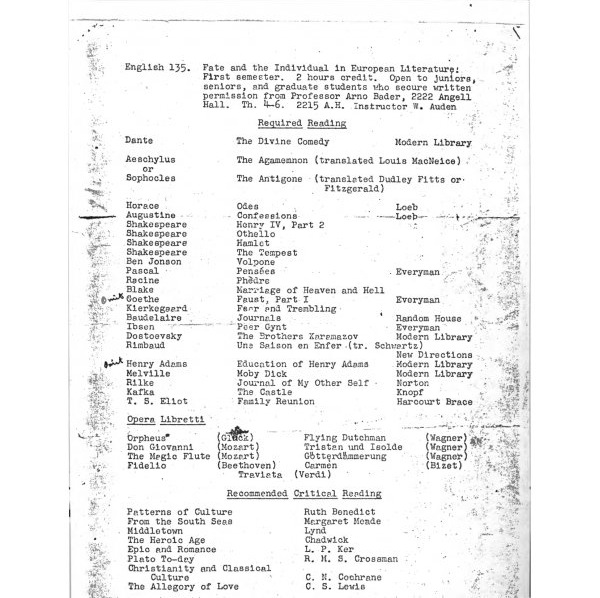
The first is that I have found myself increasingly overpowered by what I call in shorthand the “I do not understand Hegel” problem. The great theologians and philosophers of the not-too-distant past — and, still, the greatest in the present — were staggeringly, now almost incomprehensibly, literate and erudite figures. Before publishing his great work on hermeneutics, Gadamer was a noted expert on the pre-Socratics. Karl Barth is sometimes accused of not having read the tradition fairly, but he has never been accused of not having read it thoroughly. Brevard Childs seems to have truly read every book ever written. Part of what makes Hegel singularly difficult is, of course, his ruthlessly abstract and intensely tedious style; but no doubt another part is that very few people today are educated the way that he and his peers were. Take a slightly more recent example: what man of letters teaching at the University of Michigan today would dare assign his undergraduate students a reading list like W. H. Auden’s? If philosophy and theology are the Great Conversation, one must learn to discern and hear the enduring presence of the older voices who have left the room before one can truly contribute or at least understand.
The second is that, despite the immensity of my to-read list and the paucity of my already-read list, I do feel that I reached an inflection point with the turning of the year. That was when I finished reading Karl Barth’s Protestant Theology in the Nineteenth Century — the bulk of which is actually about eighteenth-century philosophy and theology as the “background” to nineteenth-century theology; and it must be said that Barth appears to enjoy writing about Rousseau, Kant, Hegel, and so forth a great deal more than the nineteenth-century theologians who are the book’s ostensible subject — and an unofficial trilogy by Lesslie Newbigin: Proper Confidence, Foolishness to the Greeks, and The Gospel in a Pluralist Society. These, somehow, coordinate in my mind: Barth and Newbigin (who was, not coincidentally, heavily influenced by Barth) together outline the negative space for and sketch the positive content of the properly Christian post-liberal synthesis which we desperately need — or which, at any rate, I need in order to feel intellectually satisfied. In the coming months, as the intellectual dust from my aforementioned reading settles, I may take a few stabs at describing what seem the chief features of that synthesis. But I also sense, if dimly, that in order to know what I really mean by those features, I will need some more pre-modern context and contrast. I can thus leave Barth and Newbigin for a little while, confident that I will return to them better able to understand what is fruitful in what they offer.
It is high time, then, that I actually read Plato and Aristotle (not to mention Seneca and Plotinus); that I (begin to) read through the Church Fathers; that I revisit Homer (and meet Vergil anew). I am doing so as follows. For Plato, I have launched into the Ukemi Audio series dramatizing the Socratic dialogues (in Benjamin Jowett’s translation), with the astounding David Rintoul as an unforgettable Socrates — and intend to write here, for my own benefit, at least a short reflection on each dialogue. For the Fathers, the obvious place to start is Volume I of the old Schaff set, with Sts. Ignatius, Justin, Irenaeus, and their comrades. With the Iliad, which I have at least read before (perhaps more than a decade ago), I have cracked open Emily Wilson’s recent translation. In none of these cases is the point a deep, doctoral-seminar level understanding. Rather, the point is familiarity, breadth, and fresh inspiration: to drink deep from the old and honored wells.